Advancing Knowledge Through Collaborative Research
New Avenues in Classroom Instruction, Assessment, and Networked Innovation (NACIAN) Journal is the official peer-reviewed research journal of Northwestern Agusan Colleges, dedicated to publishing scholarly works across the NAC Strategic Institutional Research Framework's five pillars.
Editorial Workflow
Recent Published Articles
No published articles yet
Check back soon for new research publications from the NAC community.
NAC Strategic Institutional Research Framework (NSIRF) Pillars
Human Flourishing & Ethical Leadership
Focus:
People, Well-Being, Values and Leadership
Key Topics:
- Well-being & Mental Health
- Leadership & Ethics
- Workplace Culture
- Values & Character
- Relationship & Resilience
0 published articles
Transformative & Inclusive Learning
Focus:
Teaching, Learning and Student Process
Key Topics:
- Teaching Strategies
- Student Learning & Performance
- Literacy & Numeracy
- Assessment & Feedback
- Educational Technology
- Inclusive Education
- Teacher Development
0 published articles
Equitable Governance & Social Responsibility
Focus:
Equality, Inclusion, Governance and Community
Key Topics:
- Gender Equality & Equity
- Inclusive & Fair Governance
- Safe Schools & Workplace
- Community Engagement
- Social Issues & Responsibility
- Culture, Identity & Diversity
0 published articles
Sustainable Workforce & Economic Excellence
Key Topics:
- Employment & Workforce Development
- Entrepreneurship & Innovation
- Marketing & Consumer Behavior
- Financial Management
- Business Management
- Sustainable & Responsible Business
0 published articles
Smart Systems, Innovation & Institutional Resilience
Focus:
Technology, Innovation, Environment and Preparedness
Key Topics:
- Digital Technology & Innovation
- Information & Data Management
- Smart Systems & e-Governance
- Environmental Sustainability
- Disaster Preparedness & Resilience
0 published articles
Program-Specific Research Topics Academic Program / Sector × NSIRF Pillar Matrix
The following table maps specific research thrusts and topics for each NAC academic program/sector against each of the five NSIRF pillars. Individual cells are editable by the Domain Administrator.
|
Academic Program / Sector
|
UN-SDG 3
Human Flourishing & Ethical Leadership
|
UN-SDG 4
Transformative & Inclusive Learning
|
UN-SDG 5
Equitable Governance & Social Responsibility
|
UN-SDG 8
Sustainable Workforce & Economic Excellence
|
UN-SDG 9
Smart Systems, Innovation & Institutional Resilience
|
|---|---|---|---|---|---|
|
Bachelor of Elementary Education (BEEd)
|
- Pupil motivation and engagement
- Values formation in young learners - Classroom climate and well-being - Teacher-student relationship |
- Reading Strategies & literacy skills
- Mathematics game & numeracy - Differentiated Instruction - Formative Assessment Practices |
- Gender-fair Practices in Class
- Values Education & Prosocial Behavior - Parent Involvement in Learning - Inclusive Classroom Practices |
- Financial Literacy of Pre-Service Teachers
- Career Readiness of BEEd Students - Entrepreneurial Skills for Teachers |
- Digital tools for Learner Engagement
- Digital literacy of pre-service teachers - Environmental Awareness in School - Disaster preparedness in Schools |
|
Bachelor of Secondary Education (BSEd)
|
- Academic stress & Coping Strategies
- Teacher leadership & influence - Student resilience & perseverance - Classroom relationships |
- Collaborative Learning Strategies
- Problem-based learning - Authentic Assessment - Educational Technology Use |
- Gender Awareness among Students
- Peace Education in Classroom - Civic Engagement of Students - Social media & Gender Stereotypes |
- Employability Skills of Pre-Service Teachers
- Financial Literacy among BSEd Students - Career Readiness & Competencies |
- AI-Assisted Instruction Readiness
- Digital Literacy & Academic Performance - Environmental Education - Disaster Awareness & Readiness |
|
Bachelor of Science in Business Administration (BSBA)
|
- Leadership style & effectiveness
- Job Satisfaction & Retention - Workplace motivation - Organizational Culture |
- Case-based learning in Business
- Financial Literacy & Decision Making - Digital Learning in Business - Student Engagement in Classes |
- CSR Practices of Local Businesses
- Gender equality in workplace - Ethical Business Practices - Inclusive & Fair Governance |
- Entrepreneurial Intention
- Marketing & Consumer Behavior - Financial Management Practices - Business Performance of MSMEs |
- e-Commerce Adoption of Business
- Digital Marketing Practices - Technology Adoption & Performance - Green Business & Sustainability |
|
Basic Education (Junior & Senior High School)
|
- School belonging & engagement
- Student Behavior & discipline - Values & Responsible Citizenship - Mental Health & Well-being |
- Factors Affecting Academic Performance
- Study habits & time Management - Reading Comprehension - Technology Use in Learning |
- Bullying Awareness & Help-seeking
- Students' Awareness of Safe Spaces - Student Leadership & Participation - Respect for Diversity |
- Financial Literacy & Budgeting
- Saving & Spending Practices - Entrepreneurial Intention of SHS Learners - Career Preferences of Students |
- Digital Citizenship among Students
- AI use of Learning - Waste Management Practices - Disaster Preparedness & Awareness |
|
Institutional/Faculty Research
|
- Faculty work-life balance
- Ethical Leadership & trust - Employee Engagement - Workplace Climate & Satisfaction |
- Teaching Practices & Student Outcomes
- Curriculum Effectiveness - Faculty Development Programs - Assessment Practices |
- Effectiveness of GAD Programs
- Stakeholder participation in decision-making - School-community partnerships - Safe & Inclusive Environment |
- Graduate Employability & Employer Satisfaction
- Employee Retention & Growth - Resource Management - Institutional Sustainability |
- Digital Transformation of Services
- Data Privacy & Cybersecurity - Green Campus Practices - Disaster Preparedness & Resilience |
Why Publish with NACIAN?
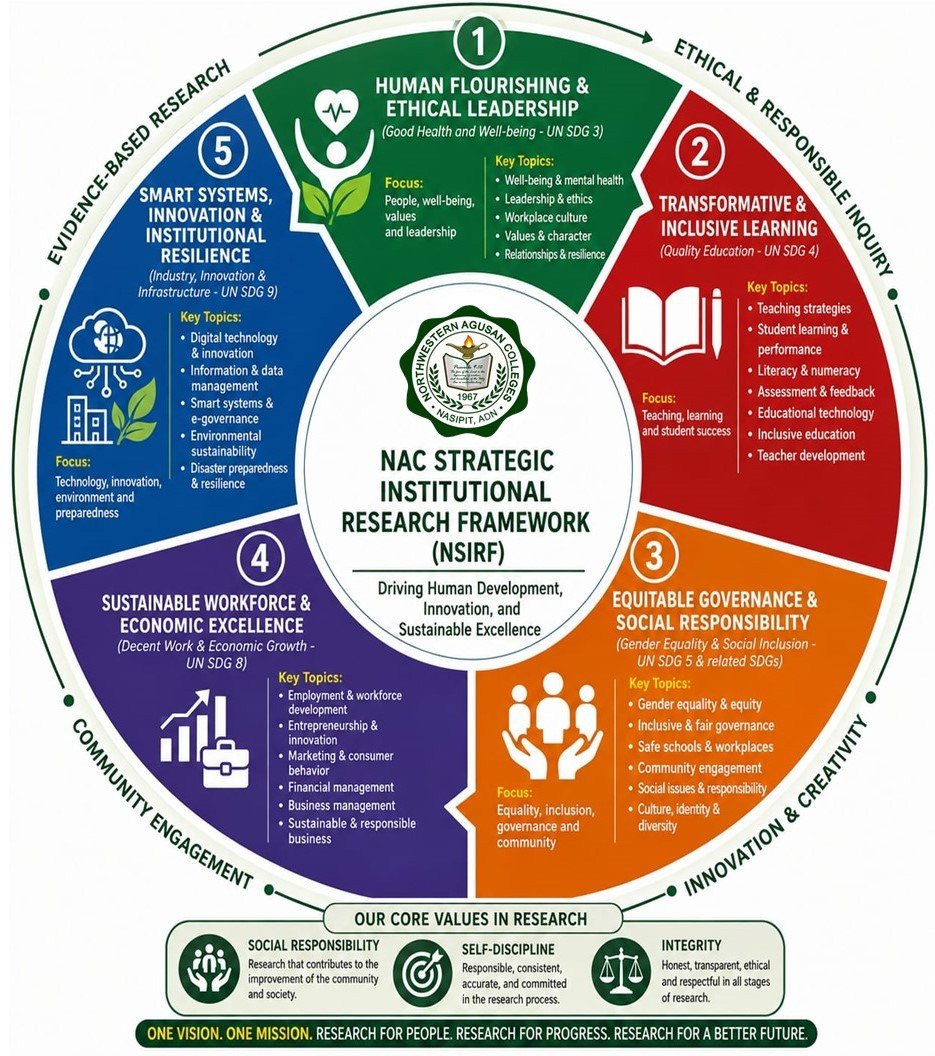
NACIAN Journal Research Framework (NSIRF) — Visual guide for research classification.