About NACIAN Journal
New Avenues in Classroom Instruction, Assessment, and Networked Innovation — the official peer-reviewed online research journal of Northwestern Agusan Colleges.
Journal Overview
NACIAN Journal is a multidisciplinary, peer-reviewed, open-access online research journal published by the Research and Development Office of Northwestern Agusan Colleges (NAC), Nasipit, Agusan del Norte, Philippines.
The journal provides a scholarly platform for faculty members, researchers, graduate students, and partner-institution collaborators to disseminate original, high-quality research aligned with the NAC Strategic Institutional Research Framework (NSIRF) — a five-pillar research roadmap anchored on the United Nations Sustainable Development Goals (SDGs).
NACIAN Journal accepts Research Articles, Review Articles, Short Communications, and Case Studies across education, social sciences, governance, technology, livelihood, and related interdisciplinary fields.
NSIRF Research Pillars
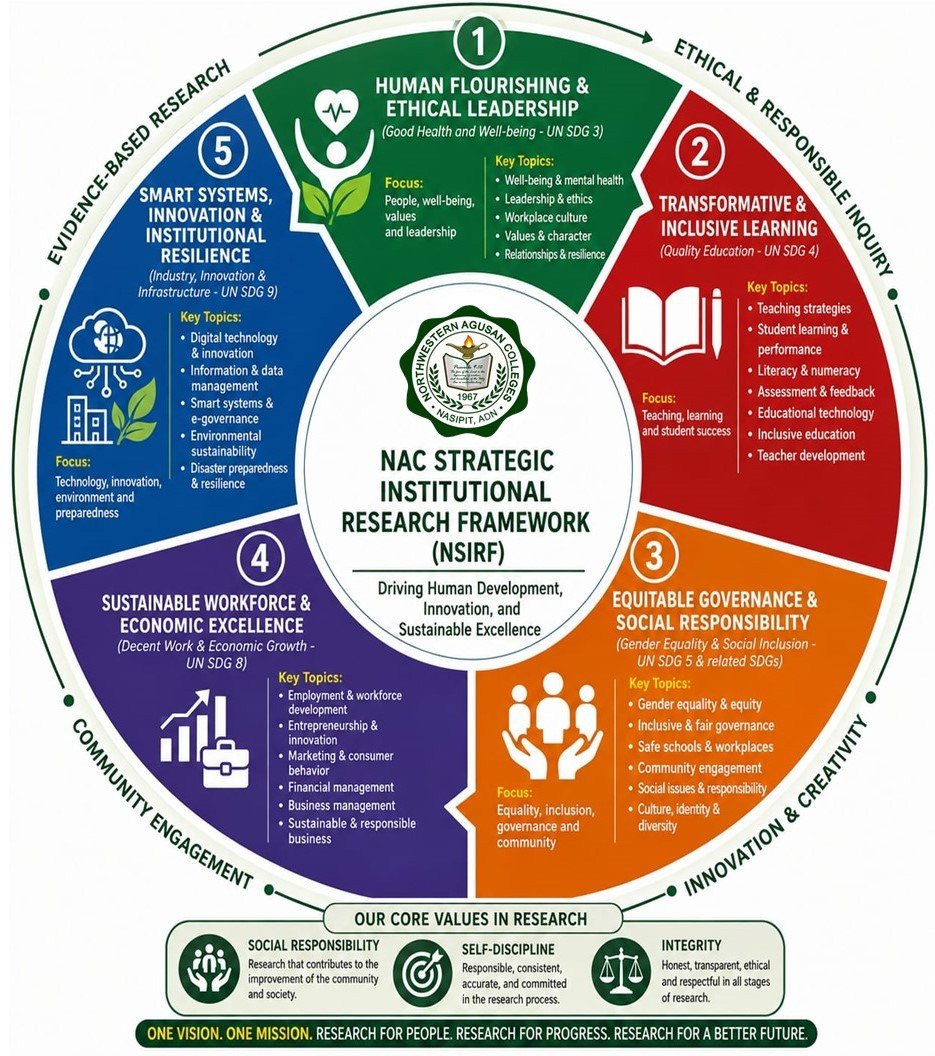
Human Flourishing & Ethical Leadership
People, Well-Being, Values and Leadership
Key Topics:
- Well-being & Mental Health
- Leadership & Ethics
- Workplace Culture
- Values & Character
- Relationship & Resilience
Transformative & Inclusive Learning
Teaching, Learning and Student Process
Key Topics:
- Teaching Strategies
- Student Learning & Performance
- Literacy & Numeracy
- Assessment & Feedback
- Educational Technology
- Inclusive Education
- Teacher Development
Equitable Governance & Social Responsibility
Equality, Inclusion, Governance and Community
Key Topics:
- Gender Equality & Equity
- Inclusive & Fair Governance
- Safe Schools & Workplace
- Community Engagement
- Social Issues & Responsibility
- Culture, Identity & Diversity
Sustainable Workforce & Economic Excellence
- Employment & Workforce Development
- Entrepreneurship & Innovation
- Marketing & Consumer Behavior
- Financial Management
- Business Management
- Sustainable & Responsible Business
Smart Systems, Innovation & Institutional Resilience
Technology, Innovation, Environment and Preparedness
Key Topics:
- Digital Technology & Innovation
- Information & Data Management
- Smart Systems & e-Governance
- Environmental Sustainability
- Disaster Preparedness & Resilience
Program-Specific Research Topics Academic Program / Sector × NSIRF Pillar Matrix
The table below lists the research thrusts and program-specific topics per NAC pillar.
|
Academic Program / Sector
|
UN-SDG 3
Human Flourishing & Ethical Leadership
|
UN-SDG 4
Transformative & Inclusive Learning
|
UN-SDG 5
Equitable Governance & Social Responsibility
|
UN-SDG 8
Sustainable Workforce & Economic Excellence
|
UN-SDG 9
Smart Systems, Innovation & Institutional Resilience
|
|---|---|---|---|---|---|
|
Bachelor of Elementary Education (BEEd)
|
- Pupil motivation and engagement
- Values formation in young learners - Classroom climate and well-being - Teacher-student relationship |
- Reading Strategies & literacy skills
- Mathematics game & numeracy - Differentiated Instruction - Formative Assessment Practices |
- Gender-fair Practices in Class
- Values Education & Prosocial Behavior - Parent Involvement in Learning - Inclusive Classroom Practices |
- Financial Literacy of Pre-Service Teachers
- Career Readiness of BEEd Students - Entrepreneurial Skills for Teachers |
- Digital tools for Learner Engagement
- Digital literacy of pre-service teachers - Environmental Awareness in School - Disaster preparedness in Schools |
|
Bachelor of Secondary Education (BSEd)
|
- Academic stress & Coping Strategies
- Teacher leadership & influence - Student resilience & perseverance - Classroom relationships |
- Collaborative Learning Strategies
- Problem-based learning - Authentic Assessment - Educational Technology Use |
- Gender Awareness among Students
- Peace Education in Classroom - Civic Engagement of Students - Social media & Gender Stereotypes |
- Employability Skills of Pre-Service Teachers
- Financial Literacy among BSEd Students - Career Readiness & Competencies |
- AI-Assisted Instruction Readiness
- Digital Literacy & Academic Performance - Environmental Education - Disaster Awareness & Readiness |
|
Bachelor of Science in Business Administration (BSBA)
|
- Leadership style & effectiveness
- Job Satisfaction & Retention - Workplace motivation - Organizational Culture |
- Case-based learning in Business
- Financial Literacy & Decision Making - Digital Learning in Business - Student Engagement in Classes |
- CSR Practices of Local Businesses
- Gender equality in workplace - Ethical Business Practices - Inclusive & Fair Governance |
- Entrepreneurial Intention
- Marketing & Consumer Behavior - Financial Management Practices - Business Performance of MSMEs |
- e-Commerce Adoption of Business
- Digital Marketing Practices - Technology Adoption & Performance - Green Business & Sustainability |
|
Basic Education (Junior & Senior High School)
|
- School belonging & engagement
- Student Behavior & discipline - Values & Responsible Citizenship - Mental Health & Well-being |
- Factors Affecting Academic Performance
- Study habits & time Management - Reading Comprehension - Technology Use in Learning |
- Bullying Awareness & Help-seeking
- Students' Awareness of Safe Spaces - Student Leadership & Participation - Respect for Diversity |
- Financial Literacy & Budgeting
- Saving & Spending Practices - Entrepreneurial Intention of SHS Learners - Career Preferences of Students |
- Digital Citizenship among Students
- AI use of Learning - Waste Management Practices - Disaster Preparedness & Awareness |
|
Institutional/Faculty Research
|
- Faculty work-life balance
- Ethical Leadership & trust - Employee Engagement - Workplace Climate & Satisfaction |
- Teaching Practices & Student Outcomes
- Curriculum Effectiveness - Faculty Development Programs - Assessment Practices |
- Effectiveness of GAD Programs
- Stakeholder participation in decision-making - School-community partnerships - Safe & Inclusive Environment |
- Graduate Employability & Employer Satisfaction
- Employee Retention & Growth - Resource Management - Institutional Sustainability |
- Digital Transformation of Services
- Data Privacy & Cybersecurity - Green Campus Practices - Disaster Preparedness & Resilience |
Editorial & Review Workflow
Every NACIAN submission follows this standardized, transparent 18-stage workflow to ensure quality, ethics, and scholarly rigor.
Draft
1/17Author prepares full manuscript with supporting documents
Submitted
2/17Author formally submits to the Editorial Secretariat
Administrative Screening
3/17R&D Officer / Admin checks formatting, completeness & ethics forms
Editorial Screening
4/17Editor-in-Chief evaluates scope, novelty, and desk-rejects if needed
AE Assigned
5/17EiC assigns a subject-matter Associate Editor
Ethics Review
6/17Ethics Committee evaluates research ethics compliance
Statistical Review
7/17Statistician validates design, analysis & interpretation (if quantitative)
Peer Review
8/17Double-blind review by 2+ subject-matter Peer Reviewers
Revision Required
9/17AE consolidates reviews and requests author revisions
Author Revision
Author responds to comments & submits revised manuscript
Re-review
11/17Reviewers evaluate the revised manuscript (round 2+)
EIC Final Decision
12/17EiC evaluates AE recommendation + reviews for final disposition
Accepted
13/17Manuscript formally accepted for publication
Production
14/17Copy-editing, typesetting, layout, proofreading
Author Proof
Author reviews and approves final galley proof
Published
16/17Article appears online in current volume/issue with DOI
Archived
17/17Permanent archival preservation in NAC R&D repository
Rejection may occur at stages 3, 4, or 12, with authors receiving documented justification from the EiC.
Author Submission Guidelines
Manuscript Preparation
- File format: Microsoft Word (.docx) or PDF
- Font: Times New Roman 12 pt, 1.5 line spacing
- Page limit: 6,000–8,000 words (incl. references)
- APA 7th Edition referencing style
- Remove author-identifying info for blind review
Required Documents
- Complete manuscript (blinded)
- Cover letter signed by all authors
- Certificate of Originality / Non-Plagiarism
- Ethics clearance certificate (if applicable)
- Copyright transfer form (upon acceptance)
Article Structure
- Title Page (separate, for admin use only)
- Abstract (200–300 words) + 5 Keywords
- Introduction / Review / Methodology
- Results & Discussion / Conclusion
- References / Appendices
Ethics & Publication Policy
- No simultaneous submission to other journals
- Plagiarism detection via iThenticate/Turnitin
- Declaration of conflicts of interest
- Informed consent for human-subject research
- Author contribution & authorship eligibility
Journal Information
Editorial Board